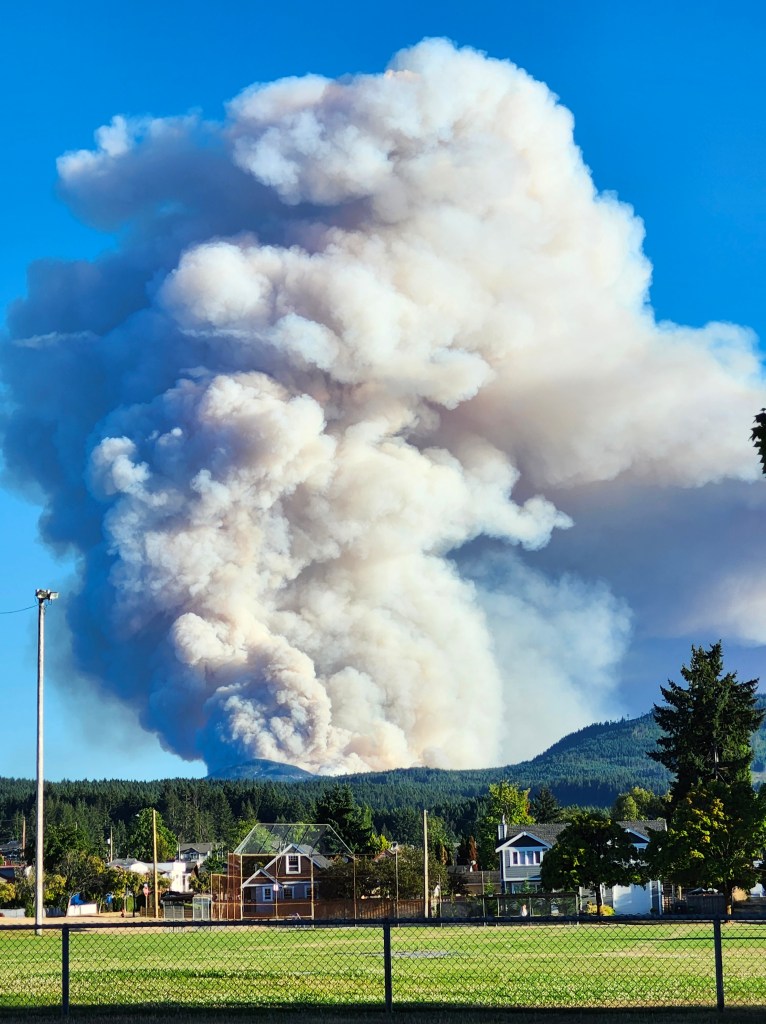
We were lucky. The usual summer winds blow up the Alberni Inlet from the south and west, especially in the afternoon. On August 11th they were blowing from the north, and for the next two days they blew from the North. That fluke of the weather saved Port Alberni.
We are still in a precarious position with respect to fire entering the city. There are many houses immediately adjacent to the tall 80 to 90-year-old forest on the South and East edges of the city. A large portion of the land adjacent to the homes is owned by the city, and beyond that land, there is another strip of Crown land before the Mosaic property is reached. I think there is a huge liability should a fire encroach on these homes. The City has a responsibility to be seen to take appropriate steps to reduce the chance of a wildfire. Unfortunately this may mean cutting some of the forest around the city limits.
This may not sit well with people in Port Alberni. But on the other hand there must be a certain amount of anxiety to those living on the south and east edges of the city. So I wonder what plans the city, and the Regional District has or is contemplating to do something to lower the chance of a wildfire encroaching on the city.
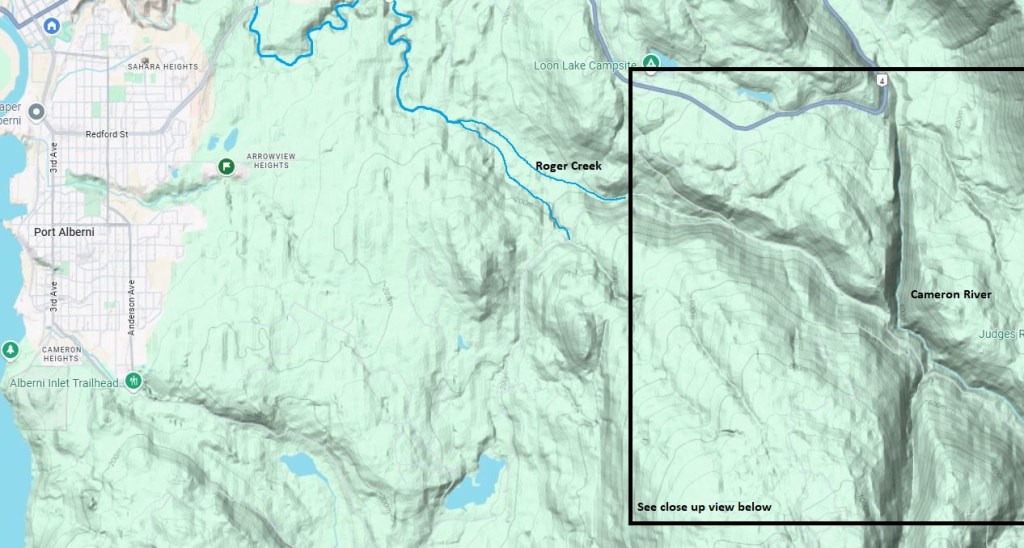
Roger Creek flows through Port Alberni into the mouth of the Somass River. It is fairly unremarkable near tidewater. But 600 meters upstream, it runs through the bottom of a canyon that that has been carved through a big slab of shale bedrock before it hits tidewater. The top is about 25 meters above the creek and the cliffs are near vertical. The canyon is about 10 km long and big enough to make me wonder where all the water came from to make such a large canyon. The upper reaches of the creek flow down from the shoulders of McLaughlin Ridge, a high plateau that forms the western slopes of the Cameron River. There is no sign of the water needed.
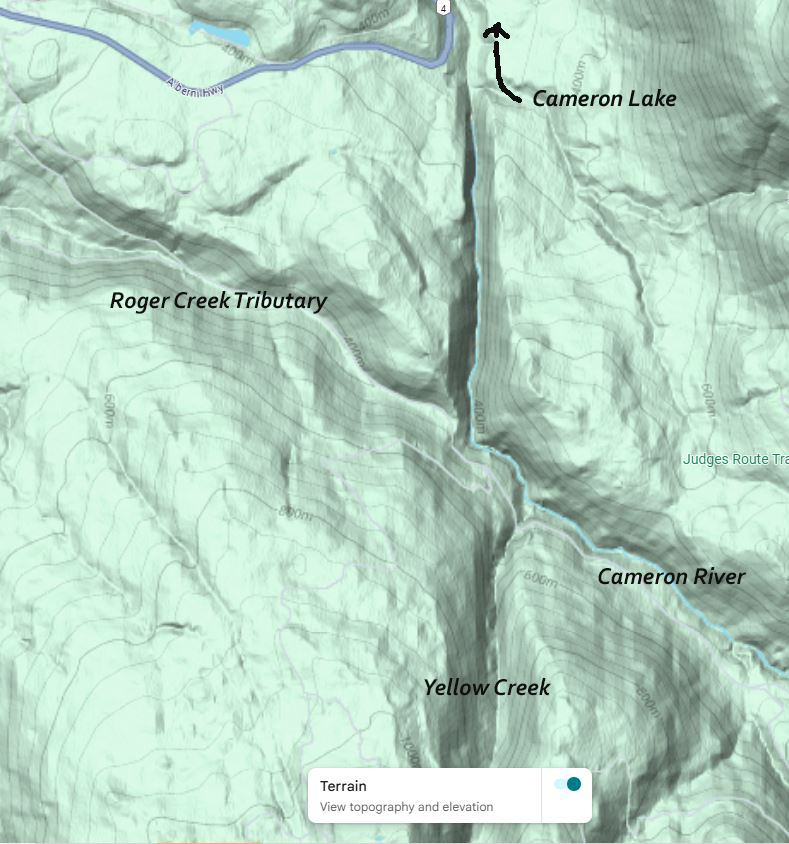
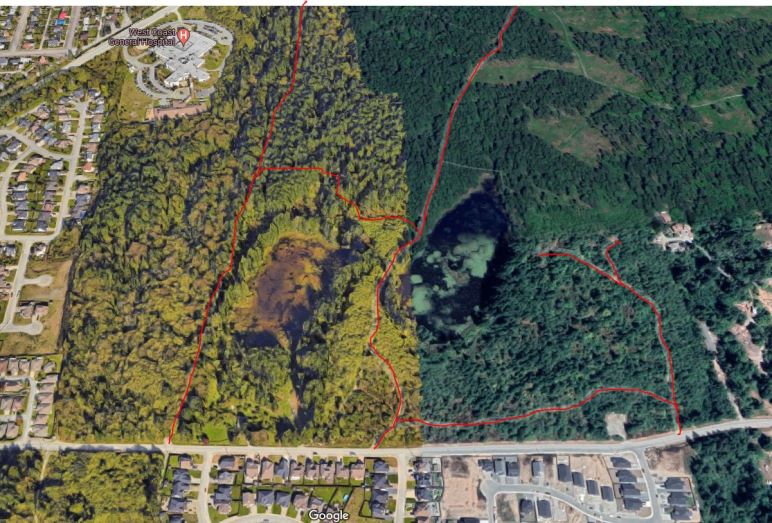
Google Maps offers a possible answer – the Cameron River. A small ephemeral tributary of Roger Creek flows from a location near the top bank of a large ravine through which the Cameron River flows. But the bottom of the ravine and the Cameron River, is 60 meters below. Confused? See the maps below.
A geologic fault line must have ruptured ages ago and either pushed up the land on the west side of the Cameron River, or dropped the land on the other side down about 60 meters. The shape of the slopes on each side of the fault are about the same. I believe this would account for the size of the Roger Creek Canyon.
On a final note, I wonder if the fact that the Hupacasath First Nation claims the Cameron River as part of their traditional territory is a result of a story about the event that changed the course of these toe streams.
A recent public engagement effort on the Log Train Trail left me thinking about decisions the ACRD has made regarding Off Road Vehicles (ORVs) on the Log Train Trail.
The ACRD Board has adopted a Management Plan that says that traffic by ORVs is around 50%, more than by all other uses combined. I’m not at all surprized. These vehicles and their reputation have figuratively driven many hikers off this trail. And now you’ll see even fewer of them. Hikers, cyclists, and horseback riders are incompatible with ORVs. They were saying that 40 years ago in my forest recreation class at university! Yet hear we are!
Some of the ACRD’s portion of the trail must remain ORV-free. That wasn’t an option in the consultant’s management plan. Did the Board have the imagination to consider this?
To me, the ACRD has dragged its feet right from the start, through the whole process of creating the Log Train Trail and maintaining it. It hasn’t abided with the agreement with the Ministry of Transportation that restricted its use to Active Transportation. Enforcement of this requirement has been negligible. Have any of the complaints been resolved by penalty?… Any? Or have they all quietly disappeared? So how can the board reps and staff speak of it as a done deal? “It just has to get by the Ministry of Transport.” We’ll see about that!
I mentioned that the reason there is so much use of the Log Train Trail by ORVs is because pedestrians are reluctant to use it. With this decision, it is completely unmanaged until a committee is struck, meets, and makes a strategy for transiting to the plan. So, do what you like folks! There are no restrictions! And they won’t enforce any that do come into play.
It really irked me to be told at the meeting that the City should have no say on the committee to implement the recommendations when they have two seats on the board.
You know, the irony of all this is that the Management Plan commissioned by the ACRD was funded by the Canada Active Transportation Fund. What is “Active Transportation”? Active transportation is using your own power to get from one place to another. This fund is set up to promote Green Transportation! Just the opposite is the result of the plan!
Devil’s Den lake is an obscure little lake you can easily hike around in an hour or so unless you really dawdle. It’s nestled at the foot of a range of big hills that form the south boundary of Sproat Lake. It is a 15 minute drive from Port Alberni. It’s perfect for a light afternoon excursion with the family.
The trail around it was built around a year ago by someone who put a great deal of work into it clearing brush and building decent bridges. No grant money went into this. The person or people who did it have done an excellent job out of the goodness of his heart. It is a beautiful lake and a beautiful hike. But, this was clearly done without any official sanction from the land owners. There are many such trails around the valley.
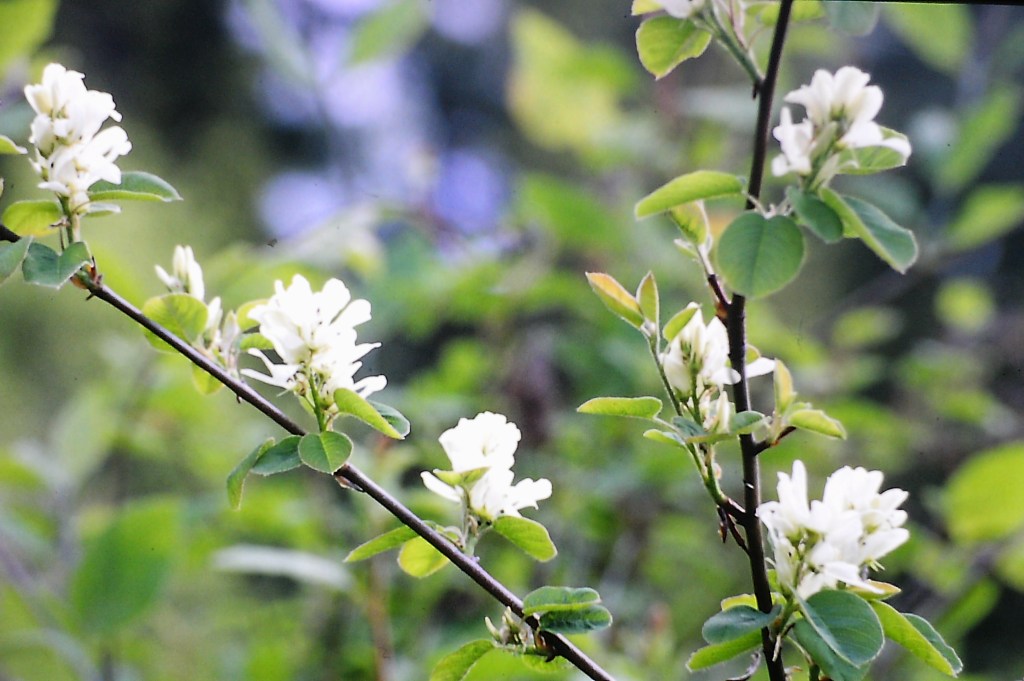
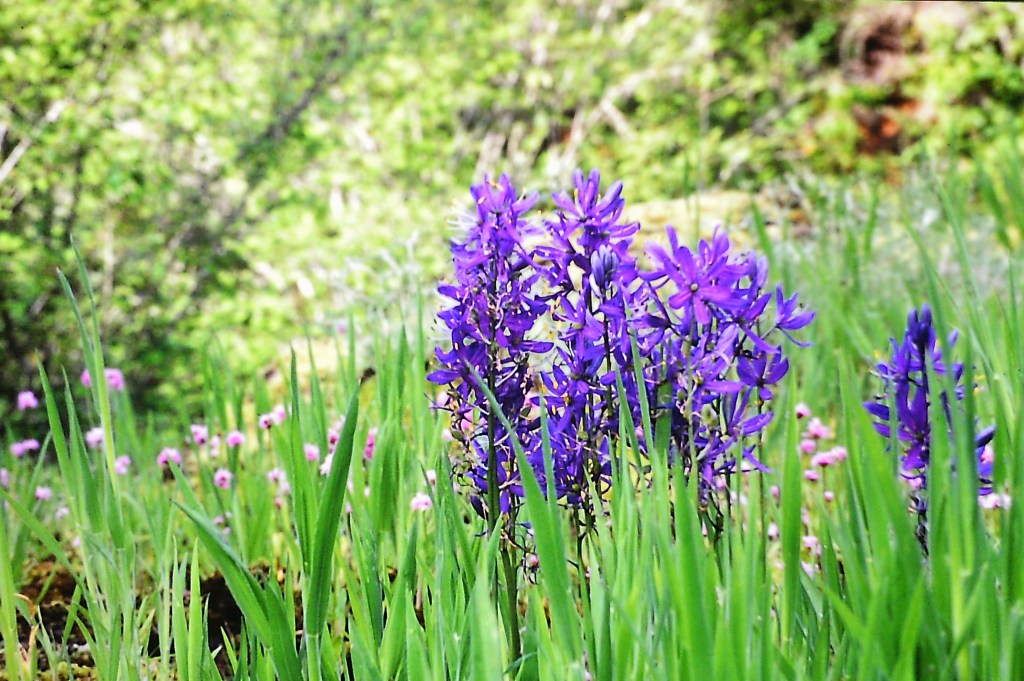
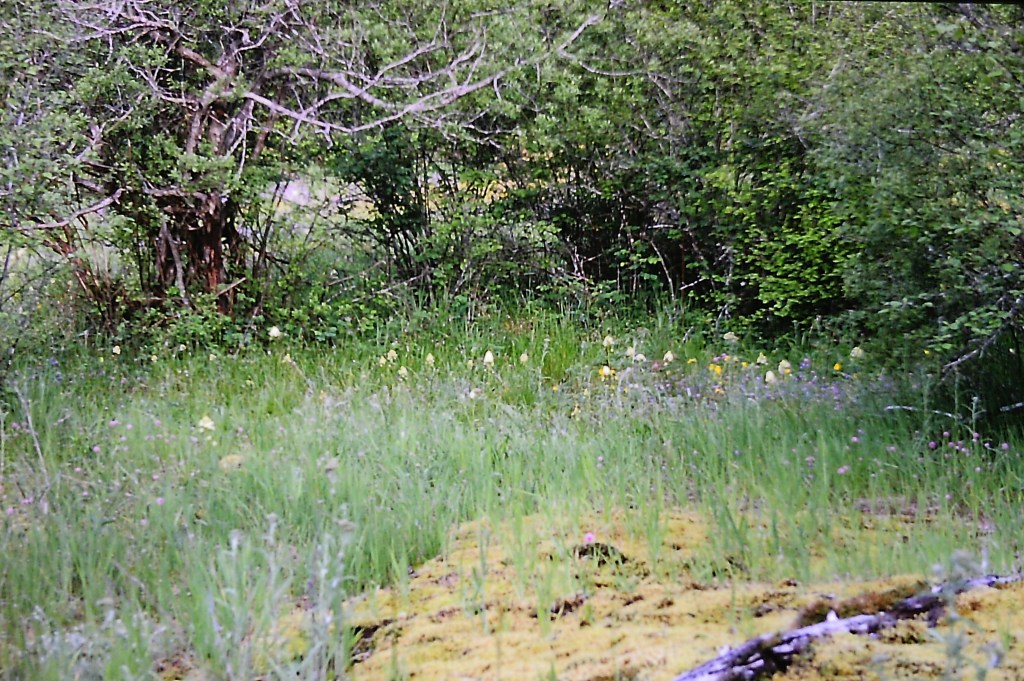
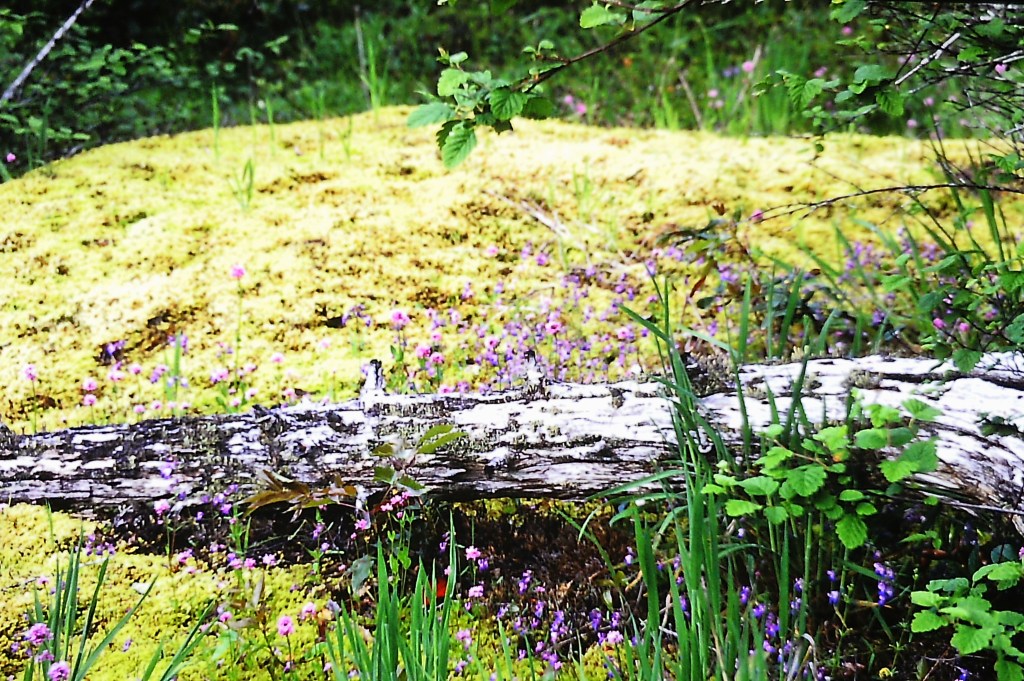
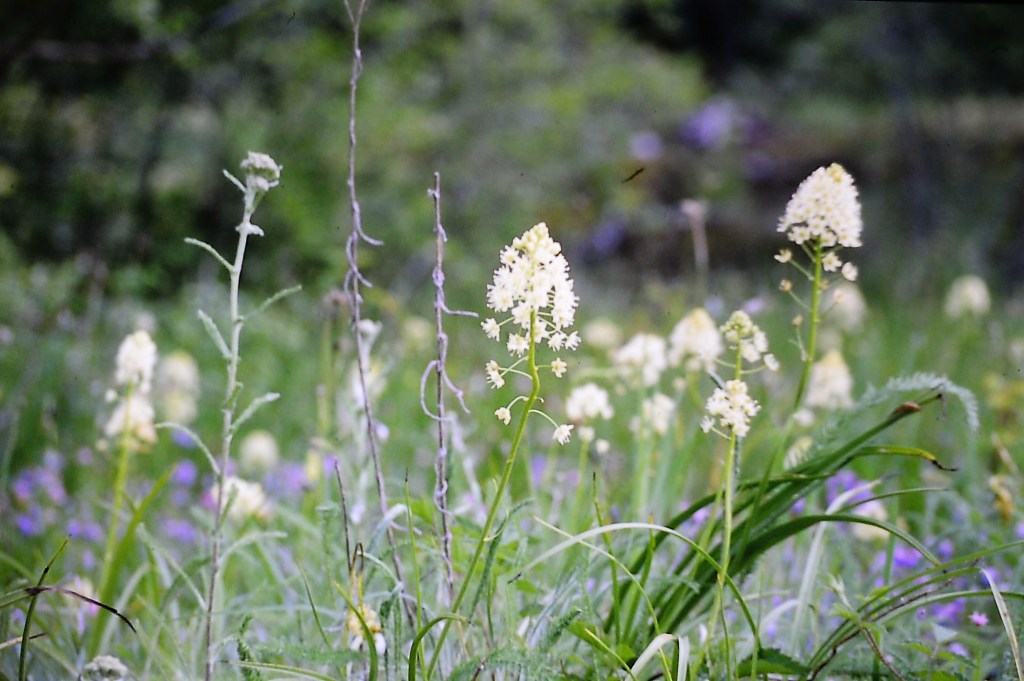
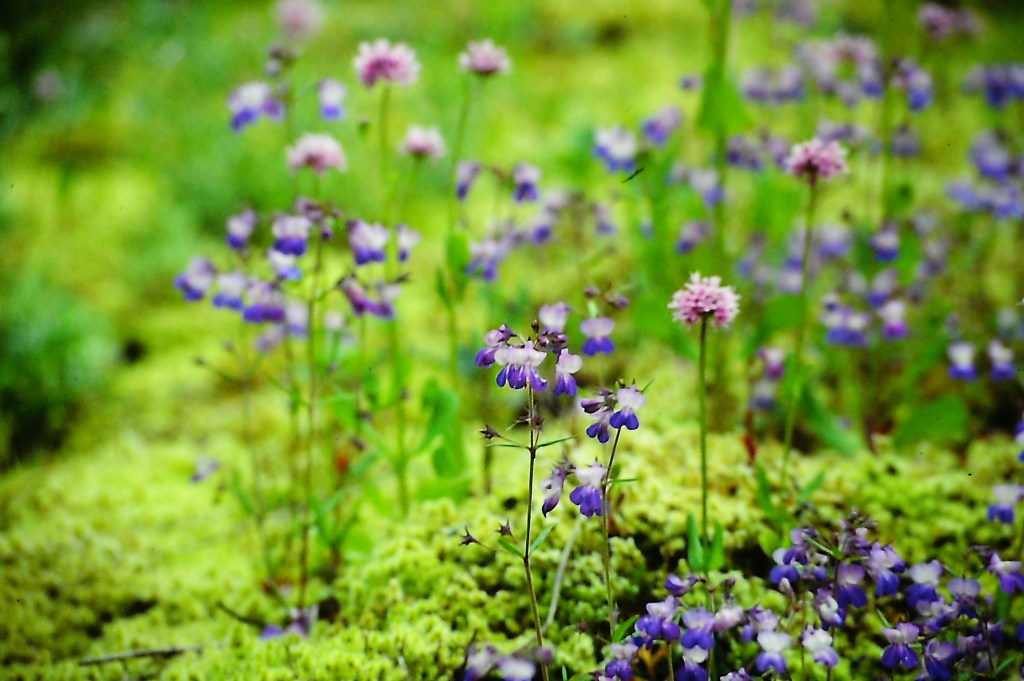
I have known about this lake for many years. I first used to take a very rough trail to the closest part of the lake, carved out by fishermen. There was a side trail that crossed (forded) the creek that drained the lake below the beaver dam. that held the lake at its current level. Then it went up to a rocky bluff that is covered in wildflowers in early May and provided a beautiful view of the lake and the mountainside beyond.
The Bluffs in1993
Bluffs in 1993
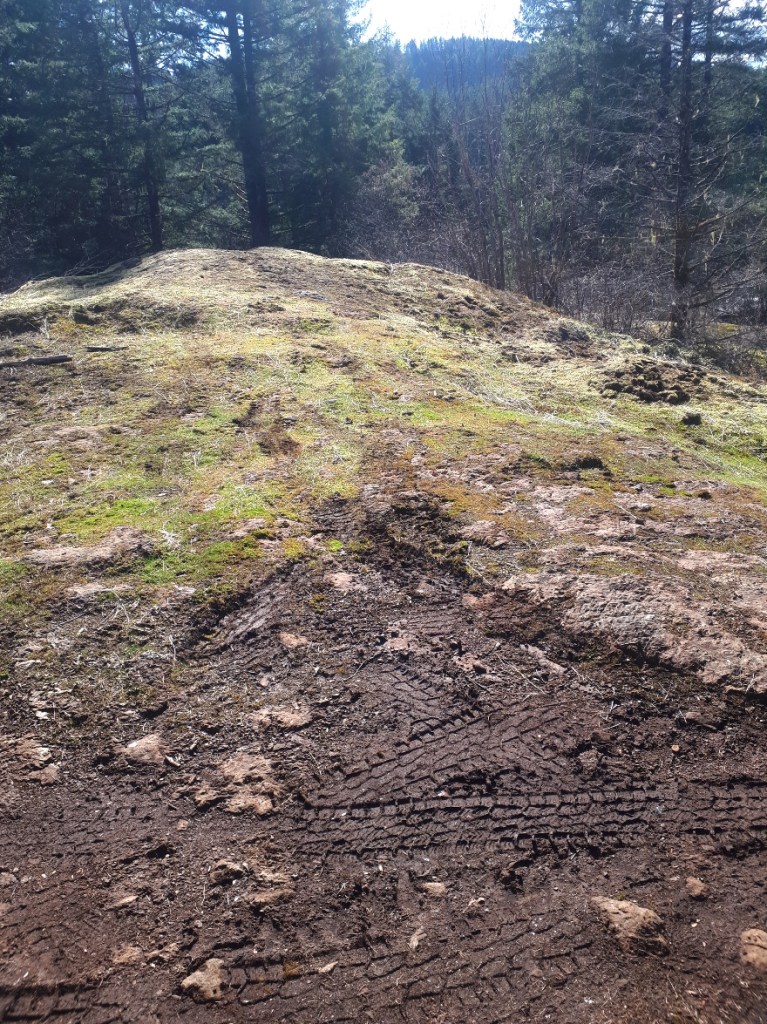
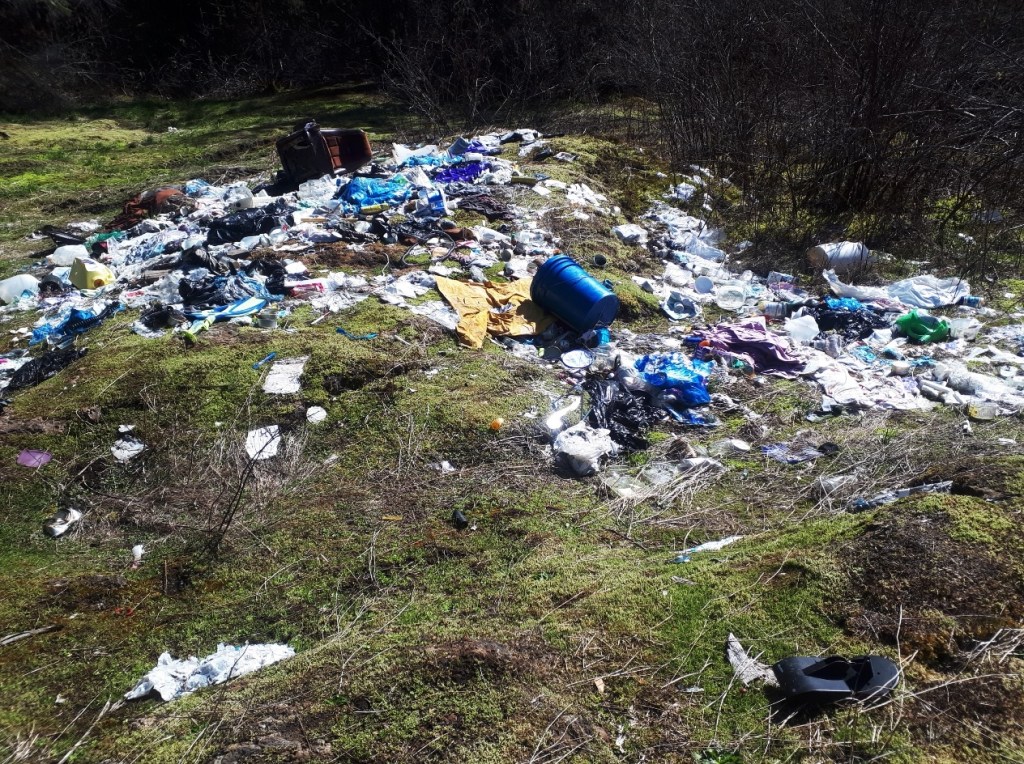
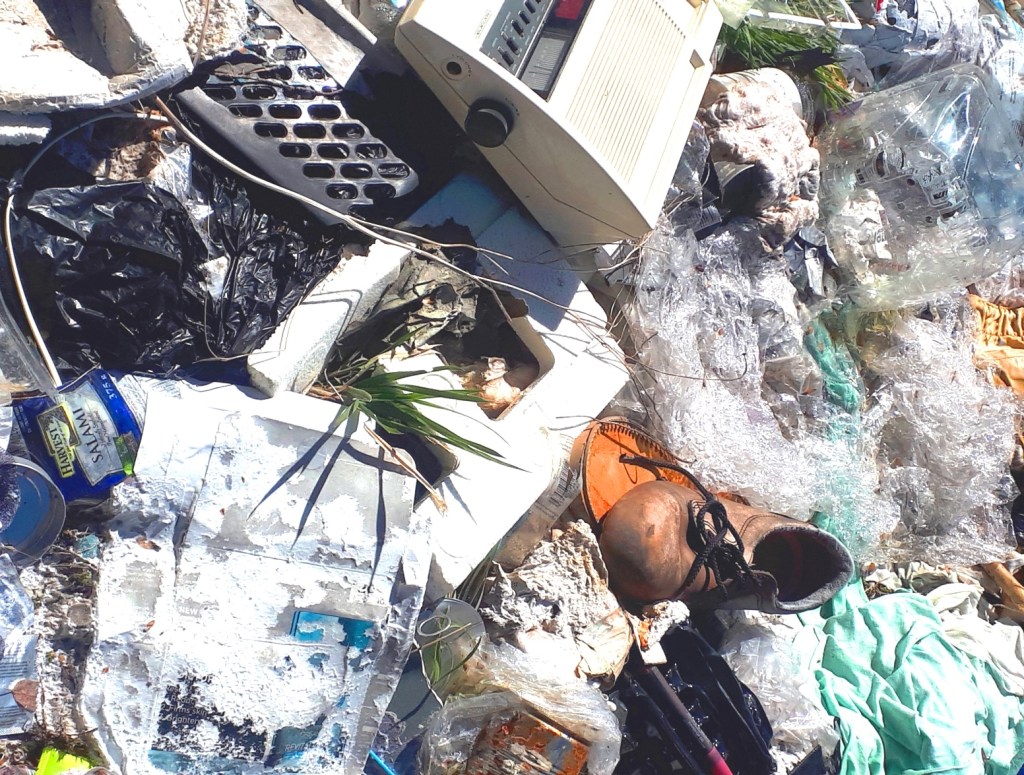
Later, I learned about another bluff just meters away through a brushy dip. the flowers there were even more spectacular. There you could find a bigger variety of them. Sadly, the fauna of both of these bluffs and others and others in the area are all being destroyed by Quad.s, or ATVs for the sake of joyriding. Not only that, they are being used to dump trash. The area has been used as a dump for quite a number of years. And it should stop.
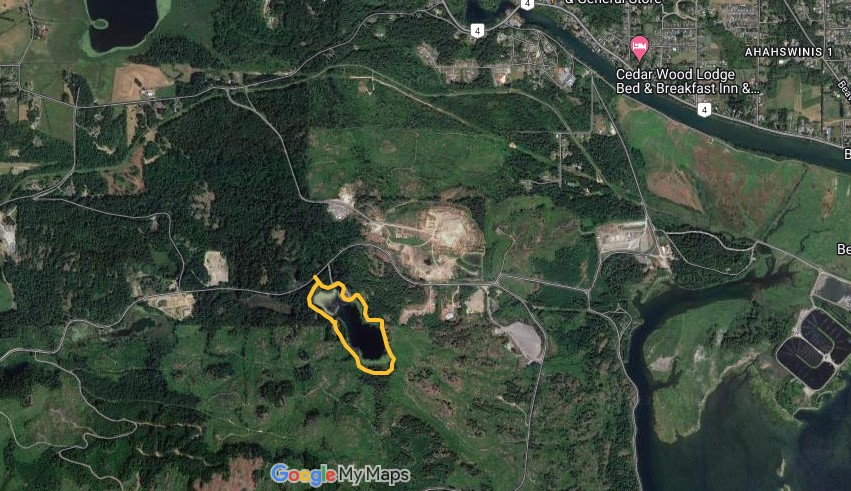
The area around the lake falls within a large block of Crown Land and also includes two creeks and 4 ponds, as well as the lake. But this property also includes a 4X4Racing track, and a private gravel pit, and part of the local land fill. The road through the property
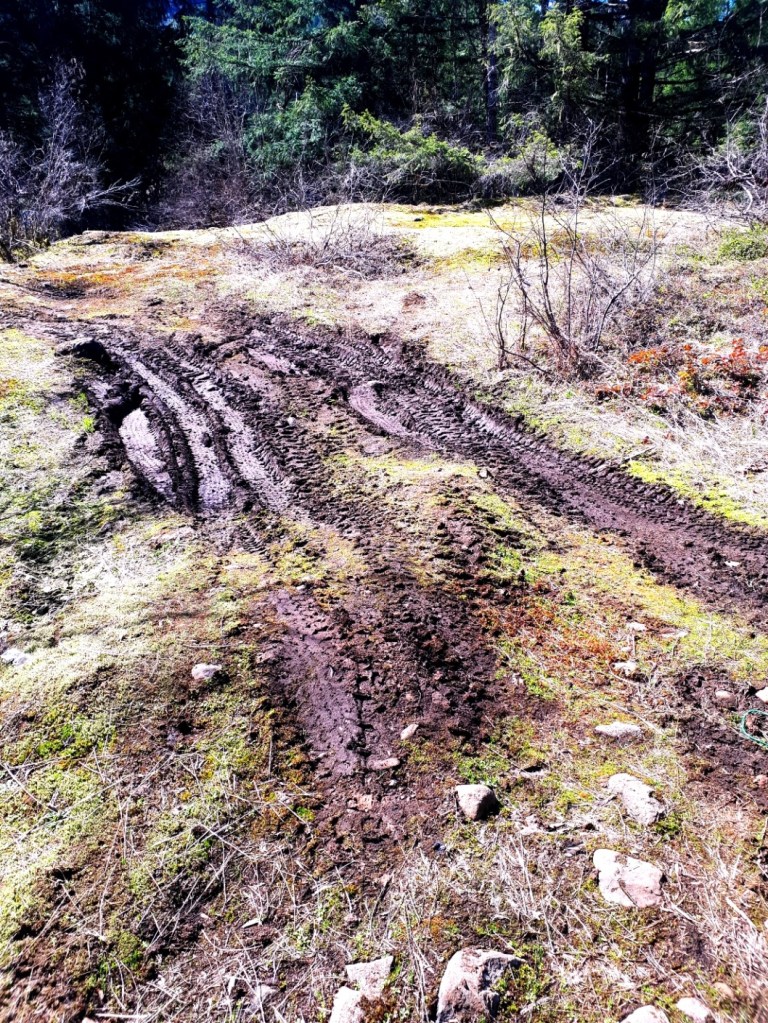
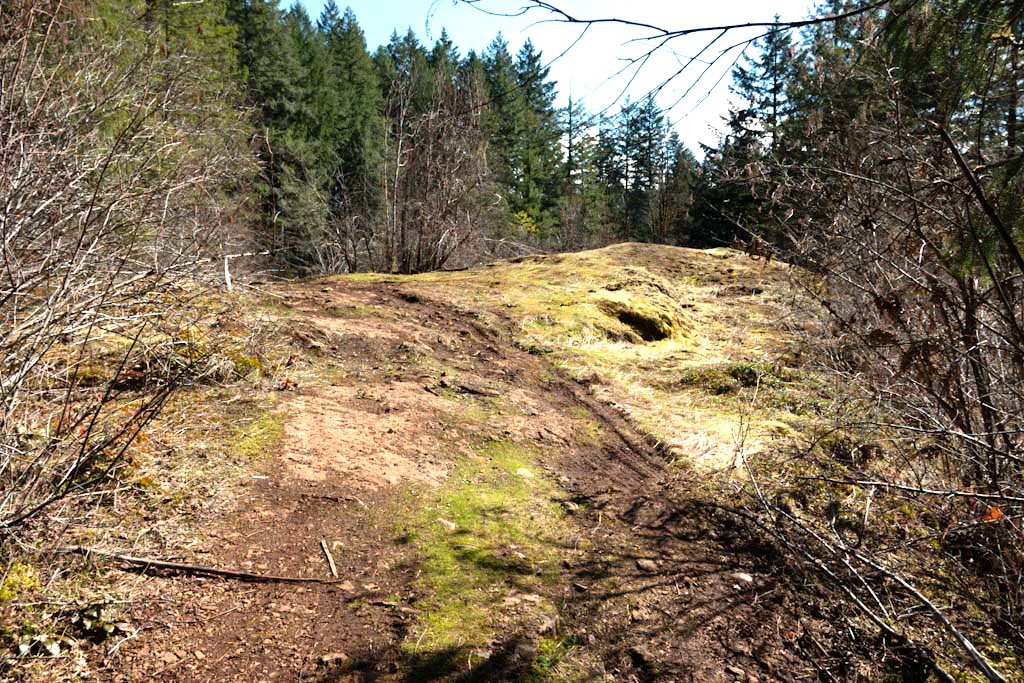
These bluffs have been driven over many, many times by ATVs, have had trash illegally dumped on them, and brought wrecked sofas on them to sit on and enjoy the view . Most of these bluffs may be irredeemably destroyed by now. I would like to see these vehicles banned and the trails they have made blocked.
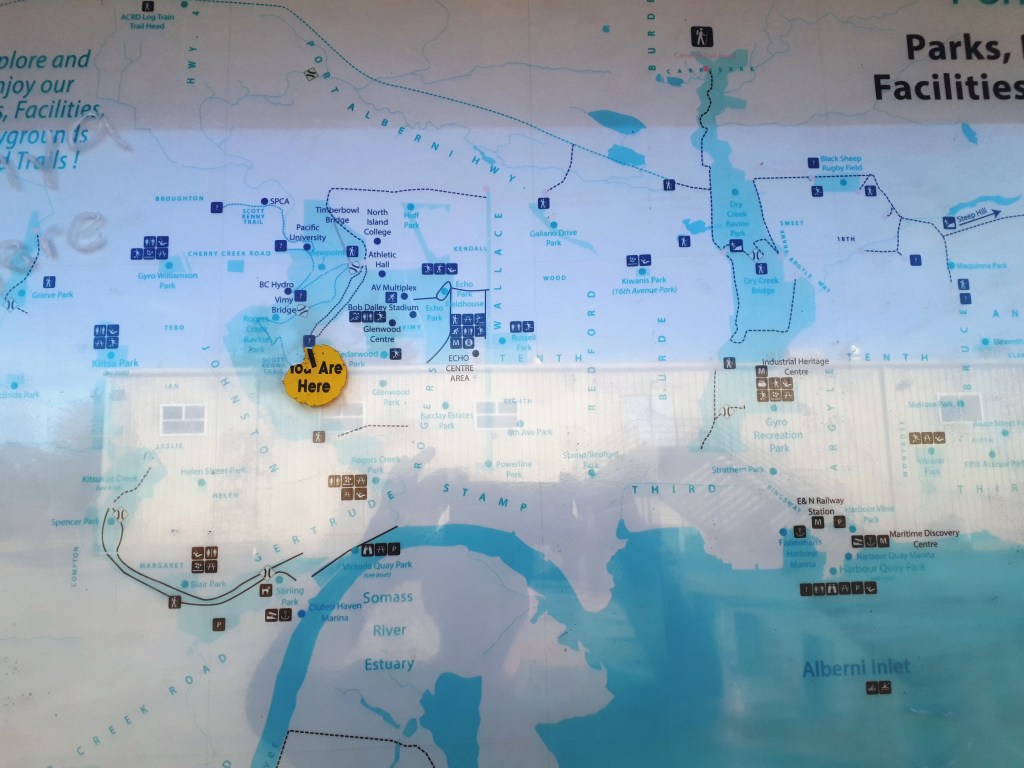
I’m actually going to make an election promise! I promise that if I am elected to city council, I will fight tooth and nail, scratching and clawing to get better signs at the trailheads around town by the end of my term. I want the trail maps to have North at the top, to have the roads visible and not just the road names, maps that aren’t so faded you can’t read them anyway. They’ve been like that for at least 4 years. It’s just embarrassing.
The Alberni Valley has never been a great place to see sandpipers (called shorebirds among birders). They generally like beaches and rocky coastlines. We see Killdeers, Spotted Sandpipers and Snipe here, the Killdeers and on farmer’s fields, Spotted Sandpipers along gravel bars of rivers and lakeshores and the Snipe in wet areas of fields.
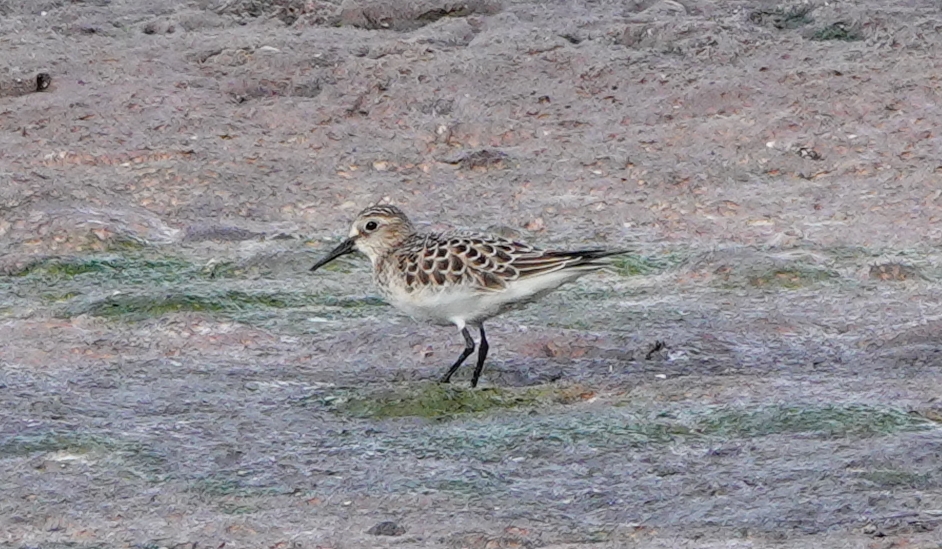
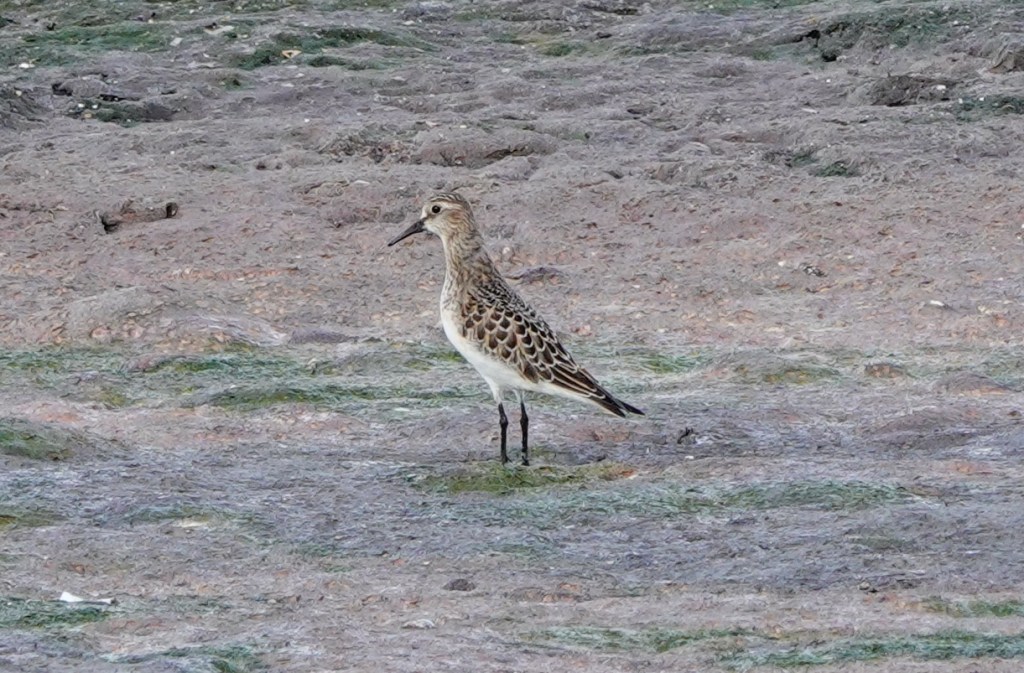
Baird’s sandpiperSame bird, different pose
But there is little habitat for the majority of the 20 sandpiper species that regularly pass through. The little habitat that exists is at what’s left of the estuary of the Somass River. And it is pretty inaccessible. For one thing, it is on the other side of the river. You need to drive through the Tseshaht Reserve along the Shoemaker Bay Road till you come to the road into the wastewater treatment ponds, on the left. It’s gated. So you need to walk in from there. That’s a 2.5 km walk along a semi-private road, before you get to the mudflats and gravel islands. And then it has to be low tide.
Or you could hop in a kayak, paddleboard or small boat to get there.
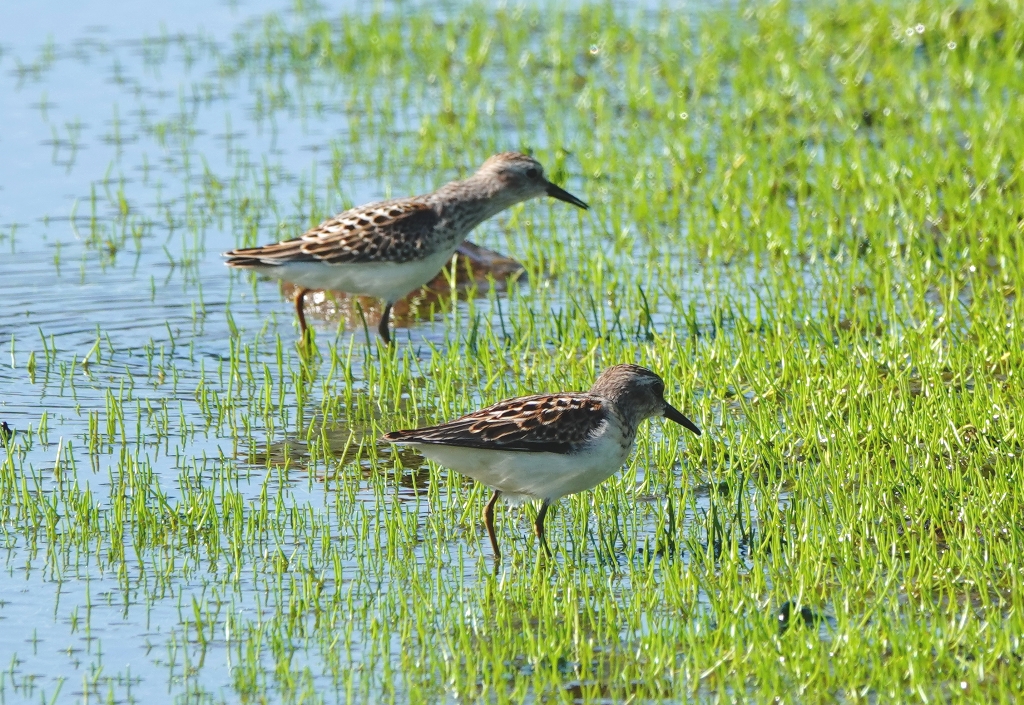
Pair of Least Sandpipers. They are the world’s smallest sandpiper.
This year however, you don’t need to go as far. The City of Port Alberni is near the end of a long construction project to update and improve the water quality of the sewage effluent into the end of the inlet. To do this, it bought the old, unused mill effluent lagoon and converted it to handle human waste. The old lagoon has been “dewatered” leaving a large puddle in the middle surrounded by sludge. It is a wonderful imitation of a mud flat. And it is attracting a nice variety of sandpipers. The walk in is almost half as long.
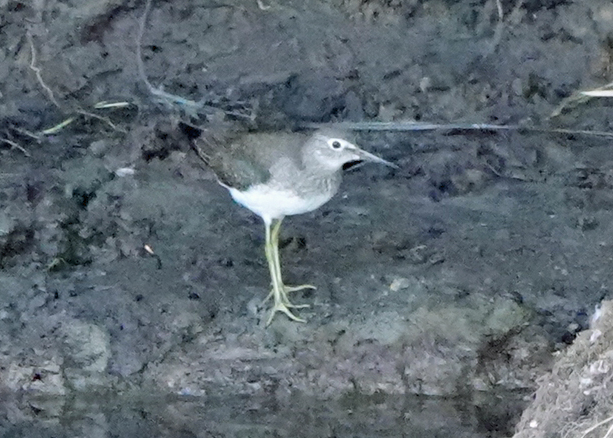
Young Solitary Sandpiper: Uncommon, you don’t see these in flocks, white spectacles and long yellowish legs.
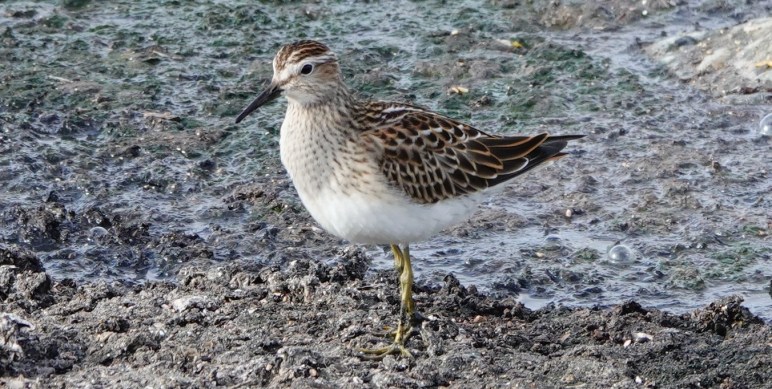
Last year 4 shorebird species were seen at the estuary in August. In contrast, this year 11 species have been recorded, including Baird’s Sandpiper, Pectoral Sandpiper, both Greater and Lesser Yellowlegs, and a Red-necked Phalarope.
Shorebirds are notoriously hard to identify. But digital cameras have made things much easier. One can now take dozens of pictures with exceptionally high performing zoom optics combined with so many features like auto focus, auto camera settings, that good pictures are pretty much guaranteed. So this has helped match the field marks that web pages tell us to look for, to the photo you’ve taken.
But I digress. It’s a good year to see shorebirds at the Somass Estuary!
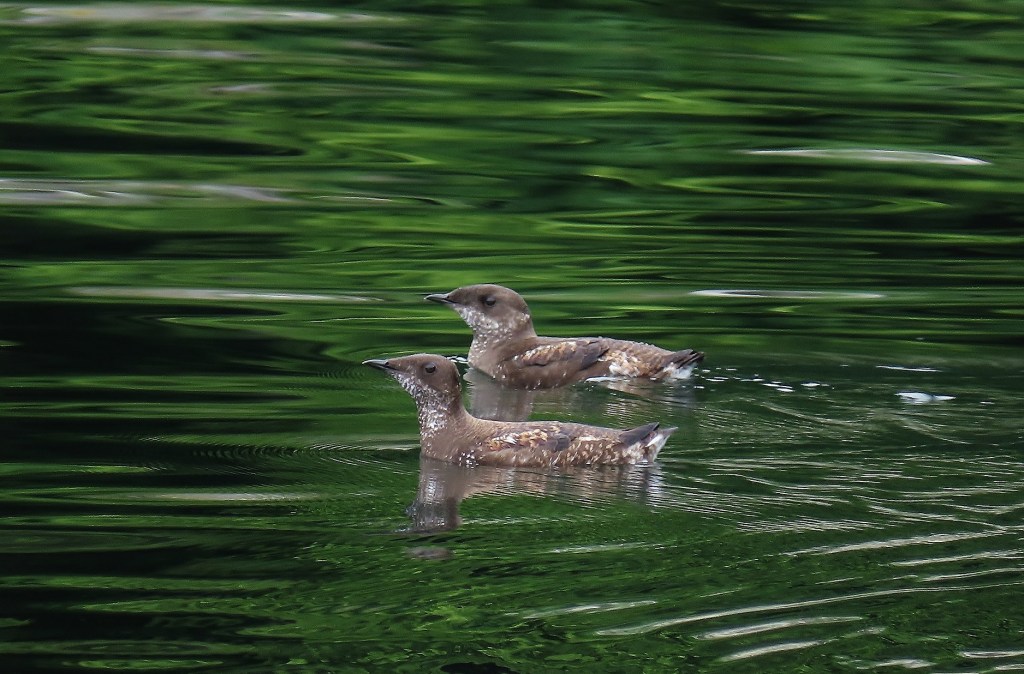
In the birding community, that means Marbled Murrelet. We use the first two letters of each word in the name… ,it’s a long story.
You may have heard of them if you have been on the West Coast for a few years. They’ve been in the news. They are one of the very few animals that require Old Forest to survive. It’s mandatory, obligatory.
Why, you might ask? Therein lies quite a story. You see Murrelets, are a kind of seabird related to puffins and auks. They spend most of their lives on water, not in trees. And they’re not exactly aerial acrobats either. Just to get airborne, they beat their wings as hard as they can, then they paddle their legs and skip across the water, sometimes plunging through a higher wave, before they get into the air. Once in the air you’ll see their shape is like a little, stout, robin-sized football. So they don’t turn easily.
The next thing to know about MAMUs, is that they nest in trees in old forest. For a long time biologists couldn’t figure out where they nested. As a rule, this family of birds nests on rocky islets and cliffs, places like that. So that’s where they searched. Until, in 1976, a tree surgeon who was cutting dead branches high in a huge old Douglas Fir in a State Campground in California. He came nose to beak with a downy young bird. Having no idea what it was, he took it to a Park Naturalist, who identified it. This was the first nest of a Marbled Murrelet ever accepted by the scientific community. Later it was realized that there were several earlier finds in British Columbia, the earliest of which was in 1955, in some old field notes discovered less than 10 years ago (Earliest Well-Described Tree Nest of the Marbled Murrelet: Elk Creek, British Columbia, 1955).
The California nest had been on thick bed of moss on a big gnarly old branch near the top of the tree. There was no actual nest, just the moss. That’s what it needs to raise its young.
So let’s go back and think about how these birds fly. They aren’t very agile in the air. So flying through forest can be tricky. The nests must be near the tops of the trees for the birds to access them. Steep slopes and trees that emerge from the general canopy are favoured. After hatching, the parents go back and forth from the ocean at dawn and dusk, feeding them fish, until they are ready to fly. And when they do fly, they get one chance to get it right. Essentially they just push off the branch and fall until their madly flapping wings catch the air. Their very first flight has to take them as much as 15 km to the ocean.
To conserve the populations of Marbled Murrelets on Vancouver Island the Provincial Government established Wildlife Reserves of old growth. There are only a couple of them around Sproat Lake. It’s not surprising since not much old growth is left there. But there are eight in the Nahmint Valley and a couple more in the Cous Creek Valley. Unfortunately Mosaic Forestry Management has no plans for setting any wildlife reserves aside.
Opinions differ as to whether what has been set aside is sufficient to ensure to viability of Marbled Murrelets in the future. Remember, old forests don’t last for ever. It just seems like it
Over the last 10 years, millions of dollars have spent up and down the east coast of Vancouver Island on salmon enhancement, and on habitat restoration. And the spending continues.
The starting 20 years ago, Campbell River estuary has been extensively restored. When I lived there, it was an industrial site with three mills on it. There was mud and concrete everywhere. Large amounts of fill had been brought in to support heavy machinery logs and buildings . Very little was left as suitable habitat for fish. That has all been restored.
Restoration of the Campbell River Estuary
Further down island large amounts of money has been spent on restoring ecological functions to the mouth of Courtenay River. Almost 4 hectares of pavement are being pulled up, a shoreline wall is being removed, waterways are being established and native plants are being reintroduced.
Restoring the mouth of the Courtenay River
Even further down island, the Englishman River has been heavily restored as well. Here, there is a similar story of fill removal, re-establishment of old drainage channels and the purchase of property.
There is much more activity between these drainages being done to “soften” the shoreline and to reduce the impact of invasive Canada Geese on the intertidal zone.
However, very little has been done to restore what’s been done to the Somass Estuary over the same time period. And that’s a shame. The Somass River is arguably the most important salmon river on Vancouver Island.
Bob Cole, who has been around the fishing scene in the community and served on many “fishy” panels and boards over the years, says that thanks to the Robertson Creek Fish Hatchery, the Somass produces more Chinook than any other river on the Island. It also produces far more Sockeye than any other river on the Island, without any help from a hatchery. In fact, only the Fraser River produces more Sockeye in BC. One year it even produced more than that river, Cole says.
One can speculate about why opportunities to do this haven’t materialized. some of it could be that priority has been going to projects in the Georgia Basin. However, this valley experiences many of the same pressures from development that the basin does. We do lack the extensive beach habitat. But we have invasive species, diked creeks, old log sorts, sewage lagoons, creeks diverted, temperature issues in the rivers, dropping populations, and more. In times gone by some work was done to improve the situation by the Alberni Valley Enhancement Association.
Two small “sedge benches” were constructed, one in Shoemaker Bay and the other a couple of hundred meters down the inlet along the Log watering road. Then Ducks Unlimited with several partners bought the area ,that was originally called the J.V. Clyne Bird Sanctuary, in 1991 from Weyerhaeuser. It includes a hay meadow a marsh north of the pipeline, a fringe of old growth next to the river, and Johnston Island. At that time a dike was built along the east boundary to prevent tide water from flooding the poplar plantation next door. this was a condition of the sale. The dike was planted with native vegetation a few years later. The access road has had two culverts replaced with bridges and a larger culvert added in another place. Lastly another bridge was added to provide smolts access to the best habitat in the estuary
Two other projects are looming on the horizon. One is the restoration of the old City sewage lagoon that will be decommissioned when the new wastewater treatment plan is brought into service. Almost $200,000 has been set aside for that. And the other, is more of an idea rather than a real project
The other one is, so far, just an idea. Former councillor, Chris Alemany is gathering support for rewilding the Dry Creek estuary, former location of the Tseshaht village before contact.
But there is still plenty to do at the Somass Estuary. Way back in 2003 the Alberni Valley Enhancement Society along with 14 other organizations from business government and conservation organization hired a consultant to write a report called the Somass Estuary Management Plan. It details many projects that could be carried out. Only a fraction of them have been acted on.
In a meeting on Tuesday morning with Mayor Sharie Minions said told that Burde Street Ponds is not the proper place for high density housing. The proper place is closer to the core areas of the city. She went on to say that the days of accepting any development proposal put before council being approved are over.
Minions went on to say that this town has changed a great deal since she was first elected to council. That we are no longer desperate. She recognises that since the announcement in August, this development proposal has a very high profile in the community, and that is important that the City proceeds properly with plenty of community participation. But community input cannot proceed until a plan and an application is in place. So it is still early days.
It seems there has been a great deal of confusion over this development on the part of the San Group and Pacific Mayfair Estates. The Initial application was incomplete. To my knowledge, they still have yet to submit a complete application. Last August they hired Mike Butler to conduct community consultation. However without a solid proposal it was difficult for him to do his job. According to San spokes person, Mike Ruttan, he ended up making commitments that he was not authorized to make. And he lost his job during the Christmas period. He emphasized that the company is making no commitments at this point. The San Group has has hired a solid architectural firm to develop a proper proposal. So things may be on the right track for them.
So, it seems we are back at square one. But, it gives those of us who are concerned about the future of this property an opportunity to find out more about the ponds and the needs of the wildlife around and in them. Here are some questions.
How far up Wolfe Creek do do salmon fry go?
Where are the Red-legged Frogs living on the property?
Where are the egg nesting grounds for the Painted Turtles?
How much of the property is necessary to sustain a family of beavers?
It’s been two-and-a-half months since the San Group gave a press conference announcing a billion dollar investment around two beautiful woodland ponds just inside the the city limits of Port Alberni. Shock waves have been rippling through the city as people digested the news. Letters of opposition have appeared in the local newspaper. A Facebook group with just under 400 members has been very active with people anxiously speculating on the impact this would have on the wildlife and atmosphere around the ponds. And the San Group has been silent until very recently.
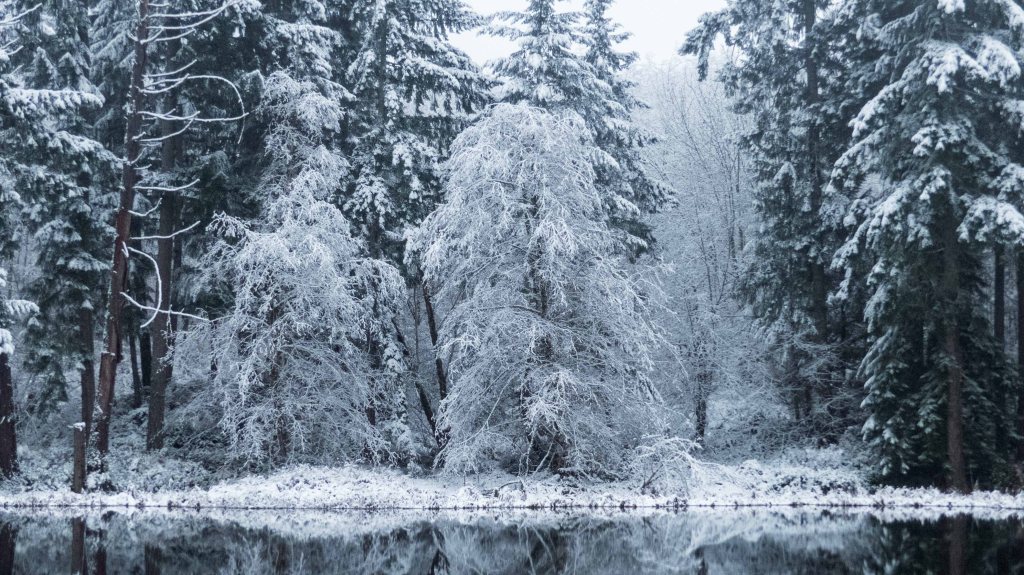
A snowy morning on the lower pond
Last Friday afternoon Mike Butler, their Marketing & Media Relation Manager, invited me to their offices for a chat. When I arrived there was something going on in the board room, I believe the Minister for Housing, also our local Member of the Legislature and her staff, were being briefed about the development. I met Mike Butler who brought me to his office. He told me they are going to amend the original application. There are a bunch of changes. Below is a list Butler sent me. I will comment on each point after this list.
They will be lowering the density by 50-55% to 1200 units,
They will be keeping the beavers,
They will be keeping trees along Log Train Trail and the trail staying where it is. They are also exploring putting the trees in a trust along the Log Train Trail to preserve them for future generations. The distance is still to be determined at various segments,
The construction techniques proposed are all to be green construction building and green energy use methods that they plan to share publicly shortly.
The 10 year to 30 year construction time-line will slowly introduce new housing in the area being respectful of existing home owners on a price and traffic level. We do plan on offering local residents lease to own options based on job qualifications. The lease to own option is still to be determined based on feedback.
They are in negotiations with the city about donation of a 30 meter setback from the ponds in trade with another piece of property the city owns.
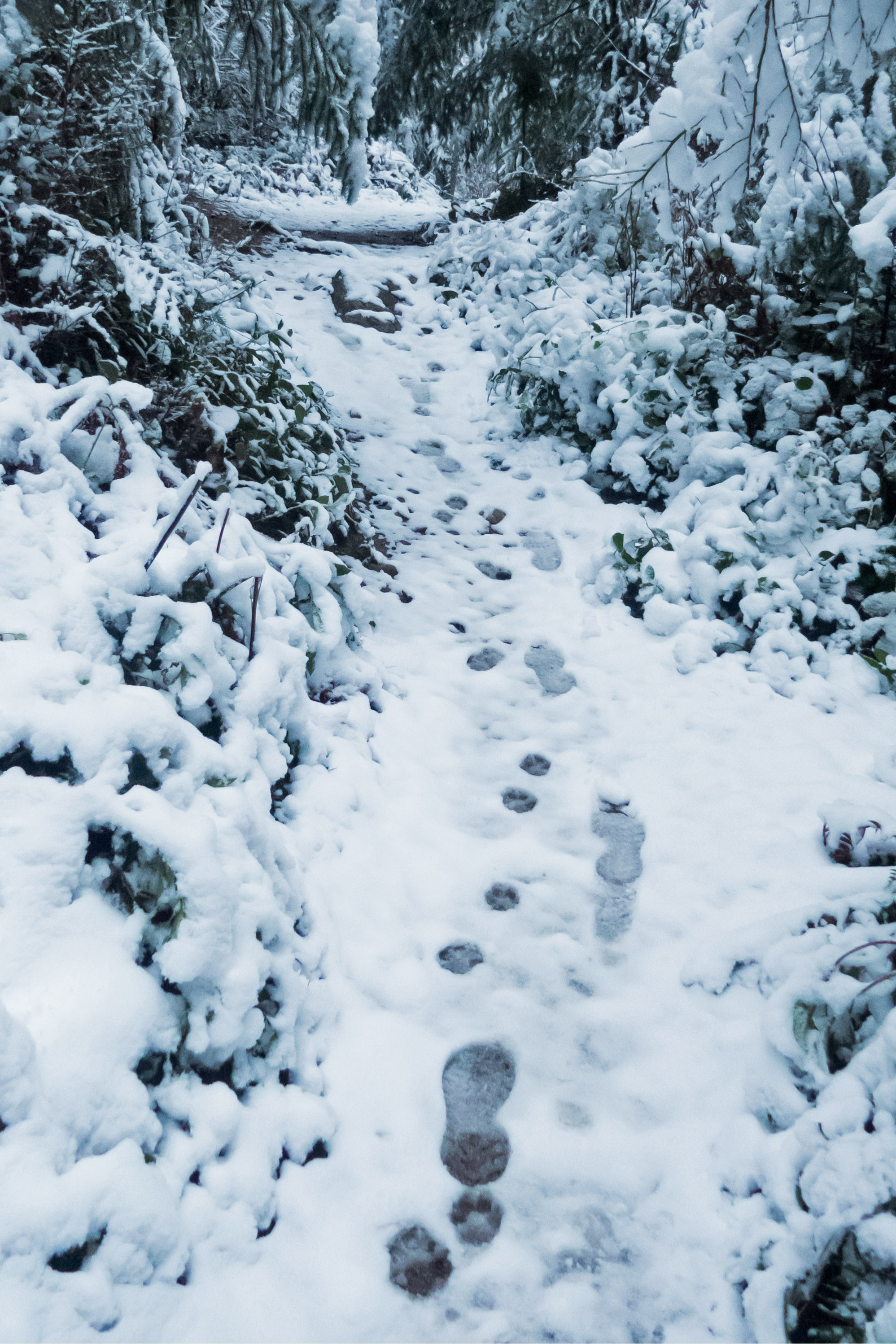
The path up to the upper pond
Lowering the density of homes to 1200 units still means that this will be a very dense neighbourhood, with at least 2400 people packed onto about 55 acres. The original property is given as 73 acres, so I deducted an estimated area of the ponds and the 5% that the city would legally require for park land. That’s about 45 people per acre. Very dense.
The consequences of such density will mean that so many parents and children will be using this area that it will quickly degenerate. Even with high fences and controlled access points, the beaver, the turtle and the ducks will leave, in my opinion. More research is needed to confirm this.
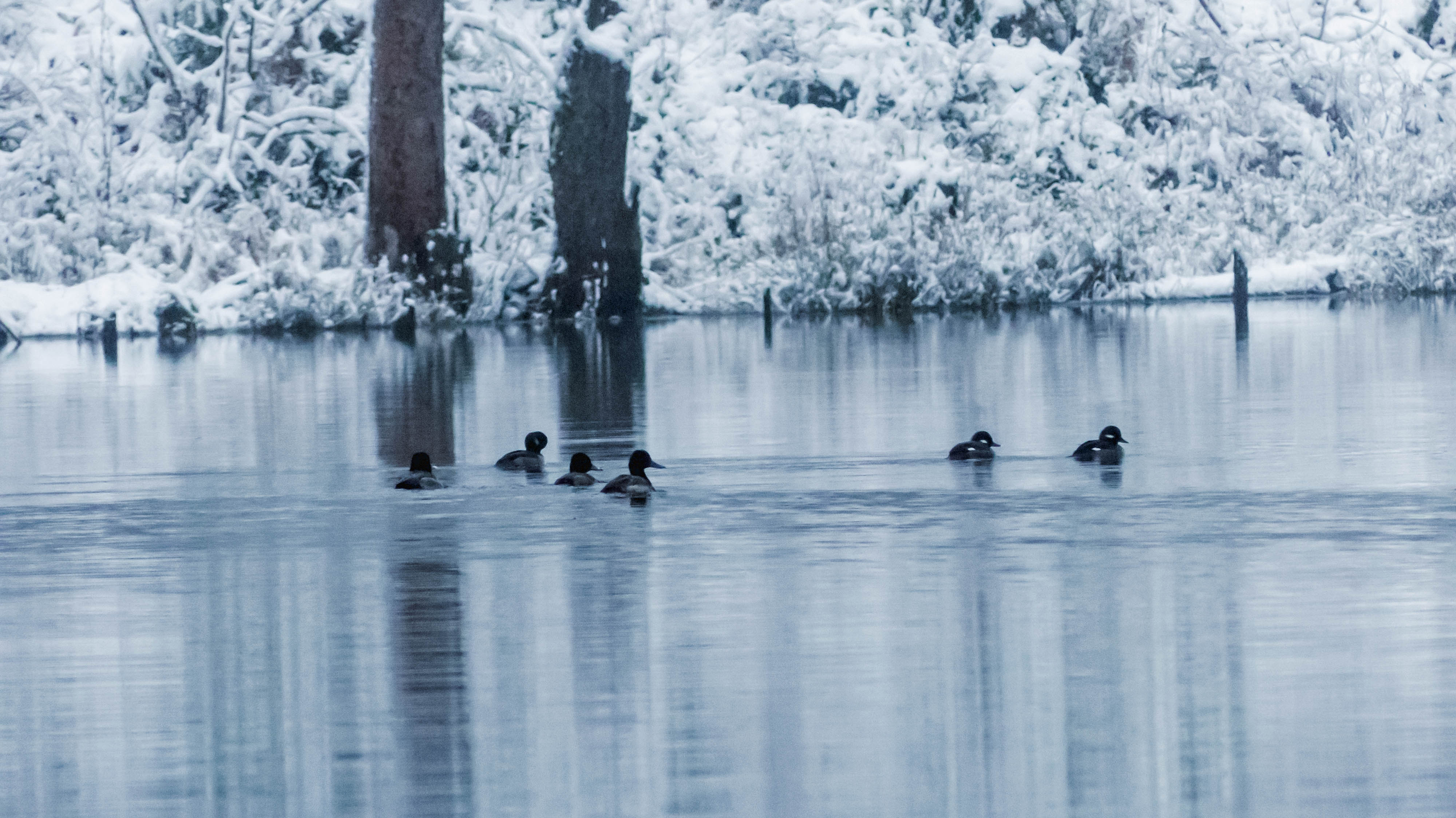
Someone and their dog got to the pond first
I’m glad they will keep the beavers. But in order to maintain their presence the habitat would have to be carefully managed to avoid disturbance in the early morning hours and in the evening hours. Enough forage must be kept in the area to ensure a food supply for them. Consideration has to made for what happens to the kits when they are old enough to leave home. Dogs should not be allowed to cool off in the ponds.
The idea of a trust for the trees along the Log Train Trail is a good one. But without anything specific, it doesn’t amount to much. This will have to be negotiated.
A partly submerged log on the upper pond
It is nice that the San Group is seriously looking at constructing the home with the environment in mind. One of Mike’s colleagues spent some time on explaining their green techniques to me. They are planning to use oriented strand board with foam sandwiched between them in panels. No mention was made about their R values. I was also shown images of solar panels. These are all good initiates but they don’t address the immediate environmental effects on the ponds themselves.
The long construction timeline may be beneficial in that it may keep options open when assessing the impact of the starting construction. Construction could start in a part of the property well away from the ponds. Originally the plan was to built over 5 to 8 years. I hope the city doesn’t get locked into unfavourable agreements that will have to be honoured 30 years down the road.
Some snags left over from when water levels were lower
The last point is very concerning. The idea that they are donating land is very misleading. Section 510 of the Local Government Act says that in a development like this the developer MUST dedicate some of their land to park. The best practise used is 5%. I don’t know where this figure comes from. I can’t find it in the legislation. I’m following this up. So the best you can say is that it is a mandatory donation that is agreeable to the city
To further muddy the water, Butler says that they are in negotiations with the city to find other property to compensate for this loss of property. Our Mayor says they are not in negotiations. There must be some mix up.









 Living in the Alberni Valley